

Crochet Projects for Stress Relief: 7 Calming Ideas
Table of Contents
- Why Crochet Projects for Stress Relief Actually Work
- 1. Granny Squares: The Classic Low-Pressure Project
- 2. Amigurumi: Focused, Rewarding, and Calming
- 3. Chunky Blankets: Full-Body Sensory Grounding
- Repetitive Crochet Stitches for Anxiety: Which Ones Calm Best
- How to Use Crochet for Mindfulness: A Stitch-Along Practice
- Best Yarn for Stress-Free Crocheting: Weight, Texture, and Color
- Ergonomics and Setup: Protecting Your Hands for the Long Run
- Frequently Asked Questions
Last Updated: September 10, 2026
Why Crochet Projects for Stress Relief Actually Work
Crochet projects for stress relief work because rhythmic stitching calms the nervous system the way meditation does. Makers often tell the same story: they sat down to make one granny square and stood up an hour later feeling lighter. The repetitive motion lowers mental chatter, gives restless hands a job, and creates something visible from a focused hour (apa.org).
The American Psychological Association's overview of stress effects on the body notes that chronic stress keeps the body in a low-grade fight-or-flight state, and that repetitive, absorbing activities help interrupt that cycle.
What Happens in Your Brain During Rhythmic Stitching
Rhythmic stitching is focused repetition, one of the oldest ways humans settle a busy mind. When your hands follow a simple, repeating stitch pattern, attention narrows to the stitch count in front of you, leaving less room for worries.
Many makers describe this as a meditative state: a soft, absorbed focus rather than a forced calm. The key ingredient is repetition, not difficulty. A simple stitch you can work almost without thinking frees your mind more effectively than a complicated pattern that demands constant counting.
1. Granny Squares: The Classic Low-Pressure Project
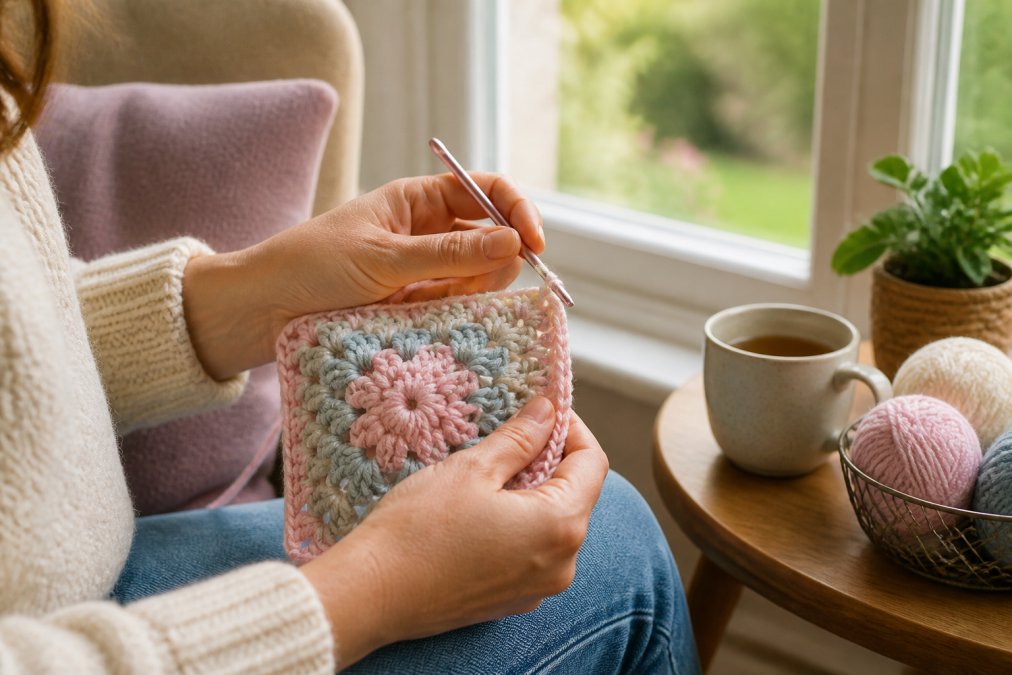
Granny squares are the best starting point for stress relief because each round repeats the same cluster of stitches, so there is almost nothing to memorize. No shaping, no counting to 200, no finishing anxiety.
That low-pressure rhythm is what makes them calming. A common mistake is choosing a complicated first project and turning relaxation into a test. Start with a single square, then join squares into a blanket later.
2. Amigurumi: Focused, Rewarding, and Calming
Amigurumi delivers a different kind of calm: absorbed focus. Small, stuffed figures like the amigurumi definition and history from Britannica describes are worked in continuous single crochet rounds, which keeps your attention anchored to the stitch count.
This is a "mindful" project rather than a "mindless" one. The counting gives your brain a single, concrete task, which many makers find more settling than free time. The reward arrives fast too: a finished figure in a weekend feels like real progress. If you are new to shaping, our intermediate-friendly Bonsai Tree Crochet Pattern walks through sculpted branches and a decorative pot step by step.

3. Chunky Blankets: Full-Body Sensory Grounding
Chunky blankets offer full-body sensory grounding: the weight of the yarn across your lap, the warmth, and the soft tactile stimulation of thick stitches pull you into the present. A large hook and bulky yarn also mean each row grows quickly, so progress is visible within minutes.
The trade-off is physical: a heavy blanket gets warm and tiring, so work in short sessions. The bean stitch used in The Finley Blanket Crochet Pattern is a simple repeating texture that feels satisfying under your fingers without demanding constant counting.
| Project | Stitch Rhythm | Mental Effort | Best For |
|---|---|---|---|
| Granny squares | Repeating clusters | Low | Beginners, low-pressure evenings |
| Amigurumi | Continuous rounds | Medium | Focused, screen-free calm |
| Chunky blankets | Simple repeats | Low | Sensory grounding, visible progress |
Repetitive Crochet Stitches for Anxiety: Which Ones Calm Best
Repetitive crochet stitches for anxiety are the simple ones: single crochet, half double crochet, moss stitch, and the shell stitch. Each repeats the same motion with minimal counting, letting the meditative state settle in.
Here is how the most calming stitches compare:
- Single crochet: The most repetitive stitch there is. Ideal for amigurumi and simple squares.
- Moss stitch: An alternating single crochet and chain rhythm. Soothing, almost hypnotic, and hard to get wrong.
- Shell stitch: A gentle, wave-like repeat that works up quickly. Our Very Shelley Bookmark Crochet Pattern uses it for a small, stash-busting project you can finish in one sitting.
- Bobble stitch: More textured and engaging. Better for focus than pure relaxation.
How to Use Crochet for Mindfulness: A Stitch-Along Practice
To use crochet for mindfulness, treat a short stitching session like a guided meditation: set a timer, choose one simple repeat, and return your attention to the stitch whenever your mind wanders. What separates a real practice from a vague intention is structure, a fixed script you repeat often enough that your hands learn it. Below are two scripts: a 10-minute session for racing-mind days and a 20-minute session for deeper reset.

The 10-Minute Stitch-Along Meditation
Use this when you have a short window or your thoughts are loud. Choose a project already in progress with a simple repeat, single crochet, moss stitch, or a granny square round.
- Settle in (1 minute). Phone in another room. Both feet on the floor. Rest your hands on the yarn before you pick up the hook.
- Set an intention (1 minute). Pick one word, "calm," "steady," "enough", to return to when attention drifts.
- Anchor to the breath (1 minute). Take three slow breaths. On each exhale, notice the weight of the yarn in your hand.
- Begin your repeat (5 minutes). Work one simple stitch across. Say the stitch name silently with each motion: "in, yarn over, pull through." Match the rhythm of your stitches to your breath, one stitch per exhale if you can.
- Notice and return (1 minute). When thoughts drift, name it without judgment ("planning," "worrying") and come back to the stitch count.
- Close (1 minute). Stop mid-row if you like. Look at what you made. Take three slow breaths before you set the hook down.
The 20-Minute Deeper Reset
When you have more time, extend the middle working block to 15 minutes and add a body scan: after five minutes of stitching, sweep attention from your jaw to your shoulders to your hands, releasing tension, then return to the stitch. This longer version works well as an evening wind-down.
Why the Script Works
The structure borrows from established mindfulness practice: a single anchor (the stitch), a return ritual (naming the drift), and a defined end. The hook does the same job a breath or mantra does in seated meditation, it gives attention one place to land. The advantage over sitting still is that restless hands have a job, which many makers find easier to sustain.
Common Mistakes That Break the Practice
- Chasing a finished object. The point is not to complete a row. If you finish the row, start another; if you don't, that's fine.
- Choosing a pattern that needs counting. Complex shaping pulls you into problem-solving, which is a different mental state than the one you're cultivating.
- Skipping the close. The final minute, looking at what you made, three slow breaths, is what tells your nervous system the session is over.
- Doing it only when stressed. A daily 10-minute session builds the association faster than an emergency-only habit.
A Note on Frequency
Most practitioners find that short, frequent sessions outperform long, occasional ones. Ten minutes most days builds the hand-mind association more reliably than an hour once a week. Keep a simple project, the right hook, and comfortable yarn together in one basket so starting takes seconds.
Best Yarn for Stress-Free Crocheting: Weight, Texture, and Color
The best yarn for stress-free crocheting is a soft, smooth worsted or bulky weight in a color you genuinely enjoy looking at. Fussy yarns, splitty fibers, and dark colors that strain your eyes add friction to what should be a calming hobby. Weight, fiber, texture, and color each affect how a project feels in the hand and how it lands on your mood, and most guides skip the last one entirely.
Yarn Weight: Match the Weight to the Mental State You Want
Yarn weight matters more than most guides admit: it changes both the physical feel and the pace of progress.
- Bulky (weight 5) and super bulky (weight 6): Fast row growth and a satisfying weight across your lap. Best for blankets and sensory projects. Trade-off: heavy on the wrists over long sessions, and warm.
- Worsted (weight 4): The versatile middle ground. Works for amigurumi, accessories, and most beginner projects. Good balance of speed and control.
- DK (weight 3) and sport (weight 2): Slower progress, finer hand feel. Better for focused work than pure relaxation.
- Fingering (weight 1) and lace (weight 0): Save these for when you want focus, not relaxation. Small hooks and fine yarn demand attention and can strain the eyes.
A common pattern is to keep two projects going: a bulky or worsted "calm" project for low-energy evenings and a finer project for when you want to be absorbed.
Fiber: What Feels Good Against Your Skin
Fiber choice is a sensory decision as much as a practical one.
- Cotton: Cool, smooth, and firm. Holds stitch definition well. Less stretch than wool, which some makers find more predictable under the hand.
- Wool and wool blends: Warm, springy, and forgiving. The slight grip of wool can make stitches easier to control.
- Acrylic: Affordable, widely available, and machine washable. Quality varies widely, soft acrylics feel pleasant; cheap ones can squeak against the hook.
- Bamboo and bamboo blends: Silky and cool. Drape beautifully but can be slippery, which some makers find less soothing to work with.
If you have sensory sensitivities, test a small swatch before committing to a full project. A yarn that feels wrong in the first ten stitches will feel wrong for the next ten hours.
Texture: Why Fuzzy Yarns Fight You
Smooth, plied yarns let your hook slide cleanly and let you see each stitch without effort. That visual clarity makes the rhythm possible, you can't fall into a meditative repeat if you're constantly hunting for the next stitch.
Color Psychology: How Palette Affects Mood During Crafting
Color is the most overlooked variable in stress-relief crochet, and it works on two levels: the color you look at while you work, and the color of the finished object you live with.
- Cool tones (blues, greens, soft teals): Widely associated with calm and quiet. A good default for evening projects or anxiety-prone sessions.
- Warm neutrals (cream, oatmeal, soft taupe, warm gray): Grounding and cozy. Easy on the eyes over long sessions and forgiving under most lighting.
- Warm brights (yellows, oranges, corals): Energizing. Better for mood-lifting projects than for winding down.
- Deep darks (navy, charcoal, black): Can strain the eyes under low light, especially with fine yarn. If you love dark colors, work in bright, even light and choose a thicker weight.
A practical approach: pick a palette that makes you want to sit down with it, not one that matches your sofa. If unsure, hold two or three skeins against your face in the light you'll actually work in, the color that makes your shoulders drop is the one to buy.
Putting It Together
For a stress-relief project, a soft worsted or bulky yarn in a cool or warm-neutral color, worked with an ergonomic hook in bright even light, is the combination most makers find easiest to settle into. Keep a small basket with one calm project, the right hook, and comfortable yarn so starting takes seconds.
Ergonomics and Setup: Protecting Your Hands for the Long Run
Ergonomics decide whether crochet stays a stress reliever or becomes a source of pain. Repetitive motion strain builds quietly, and the fix is mostly setup: an ergonomic hook, good posture, and regular breaks.
A few practical adjustments make a big difference:
- Hook ergonomics: A thicker-handled or ergonomic hook reduces the grip force needed, which eases strain in your thumb and wrist.
- Posture: Sit with your elbows supported and your work at chest height. Slouching over your lap is the fastest route to a sore neck.
- Breaks: Stand and stretch every 20 to 30 minutes. Set a timer if you tend to lose track of time.
- Lighting: Work in bright, even light so you are not leaning in to see your stitches.
Tracking which projects you finish and how you felt during them helps you spot patterns over time. Our FREE Ultimate Crochet Planner includes project planning pages and a yarn stash inventory, so you always have a calming project ready to pick up.

Frequently Asked Questions
Can crochet really help with stress?
Yes. The repetitive motion of crochet triggers a meditative state similar to deep breathing exercises. Rhythmic stitching lowers cortisol and promotes relaxation. Many crocheters describe a sense of calm and mental clarity after just 20 minutes of working on a simple project. The key is choosing low-pressure patterns that let your hands move without demanding constant counting or complex decisions.
What are the best beginner-friendly crochet projects for relaxation?
Start with granny squares, simple scarves, or dishcloths. These projects use basic stitches, tolerate mistakes, and let you focus on the rhythm of repetitive motion rather than precision. The Very Shelley Bookmark Crochet Pattern ($1.99) is another excellent option: it works up quickly, uses minimal yarn, and produces a finished piece in one sitting, which gives you a satisfying sense of completion.
How does repetitive stitching affect the brain?
Repetitive motion activates the parasympathetic nervous system, which slows heart rate and reduces anxiety. The focus required for stitch count also interrupts rumination, pulling your attention into the present moment. This combination of sensory grounding and creative flow creates the same calming effect as meditation or gentle yoga. Complex patterns can break this rhythm, so keep your project simple when you want maximum tension relief.
Is crocheting good for ADHD and anxiety?
Many people with ADHD find crochet helpful because it provides tactile stimulation and a productive outlet for restless energy. The repetitive patterns keep hands busy while the brain focuses on a single task, which can improve concentration. For anxiety, the meditative state of rhythmic stitching offers emotional regulation without requiring formal meditation practice. The Crochet Journal Printable ($1.99) can help you track which projects work best for your focus and mood.
Stress builds quietly, and so does relief. The trick is having a project on hand that asks little of you and gives back a calm, focused hour. Crochet Creations Hub offers instant-download patterns for every mood, from quick shell-stitch bookmarks to cozy textured blankets, plus free planning tools like the 120-page Ultimate Crochet Planner to keep your next project ready when you need it. Get your free pattern and turn a restless evening into a restful one.