

Affordable Crochet Patterns for Beginners (2026)
Table of Contents
- Essential Crochet Tools for Beginners (And What You Can Skip)
- Easy Crochet Stitches for Beginners: The Only Four You Need First
- How to Read Crochet Patterns for Beginners Without Getting Lost
- 10 Affordable Crochet Patterns for Beginners Worth Starting Today
- Recommended Yarn Weights and Budget-Friendly Yarn Alternatives
- Troubleshooting Common Beginner Crochet Mistakes
- Where to Find Affordable Crochet Patterns for Beginners Online
- Conclusion
Last Updated: August 12, 2026
Picking up a crochet hook for the first time feels exciting until you open a pattern and encounter "ch 3, sc in 2nd ch from hook." At Crochet Creations Hub, we hear this from beginners constantly. The good news: affordable crochet patterns for beginners are everywhere, and the learning curve is far shorter than most people expect. This guide gives you exactly what you need to start, finish, and enjoy your first ten projects.
We'll cover the tools worth buying, the four stitches that cover 90% of beginner projects, how to decode pattern instructions, and ten project ideas ranked by difficulty. We'll also show you where to find free and low-cost patterns.
Essential Crochet Tools for Beginners (And What You Can Skip)
Essential crochet tools for beginners come down to five items: a hook, yarn, stitch markers, a tapestry needle, and scissors. Everything else is optional until you know you'll stick with the craft.
The most important purchase is your hook. A size 5mm (H/8) aluminum hook pairs well with worsted weight yarn, the standard choice for learning. Ergonomic hooks with cushioned handles cost more but make a real difference if you plan to crochet for extended periods. Beginners with any hand stiffness should prioritize ergonomics from day one.
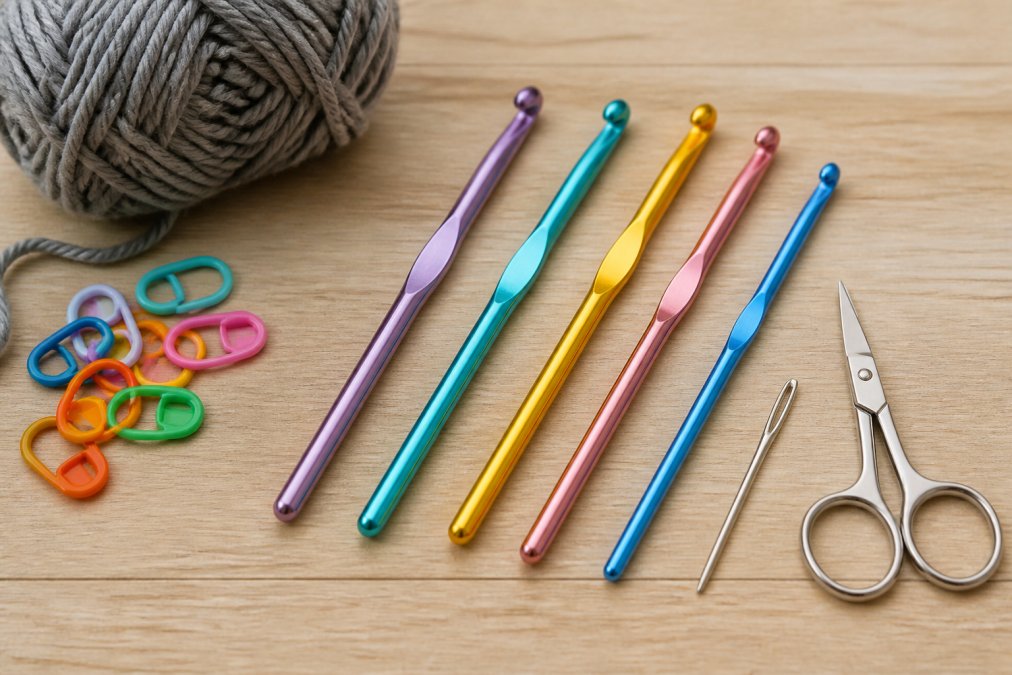
Stitch markers prevent the most common beginner frustration: losing count of your stitches. A tapestry needle is essential for weaving in ends. You can get all five essentials for well under $20 if you buy them separately rather than in a branded kit.
Budget-Friendly Starter Kits vs. Buying Separately
Starter kits look appealing, but many include hooks in sizes you won't use for months. Buying separately lets you spend more on one good hook and quality yarn, which directly affects how enjoyable the process feels. The real waste in most kits is the included yarn: thin, scratchy, and hard to see your stitches. Replace it with a ball of smooth worsted weight acrylic before you cast on your first row.
| Item | Needed Now | Can Wait |
|---|---|---|
| 5mm aluminum or ergonomic hook | Yes | - |
| Worsted weight acrylic yarn | Yes | - |
| Stitch markers | Yes | - |
| Tapestry needle | Yes | - |
| Scissors | Yes | - |
| Crochet gauge ruler | No | After first 3 projects |
| Yarn swift or winder | No | When buying hanks |
| Blocking mats | No | For garments only |
Easy Crochet Stitches for Beginners: The Only Four You Need First
Master four stitches and you can complete the majority of beginner patterns published online: the slip knot, chain stitch, single crochet, and double crochet.
Slip Knot, Chain Stitch, Single Crochet, and Double Crochet
Slip knot: Make a loop with your yarn, pull the tail through to create an adjustable knot, and place it on your hook. It should slide snug without being tight.
Chain stitch (ch): Yarn over, pull through the loop on your hook. Repeat. This is your foundation and your turning chain at the start of each row.
Single crochet (sc): Insert hook into the designated stitch, yarn over, pull up a loop (two loops on hook), yarn over again, pull through both loops.
Double crochet (dc): Yarn over, insert hook, pull up a loop, yarn over and pull through two loops, yarn over and pull through the final two loops. The workhorse stitch for blankets and scarves.
Tension is the single biggest variable for beginners. Crochet gauge, which measures how many stitches and rows fit into a 4-inch square, only matters for wearables and fitted items. For scarves, dishcloths, and amigurumi, gauge is forgiving. Focus on keeping consistent tension rather than matching a specific gauge until you're ready for garments.
How to Read Crochet Patterns for Beginners Without Getting Lost
Read the entire pattern before you begin. Patterns list the hook size, yarn weight, finished dimensions, and skill level at the top. Skipping that section is the fastest way to get halfway through a project and realize you're using the wrong hook.
Every pattern uses crochet abbreviations. These are standardized in the US, so once you learn them, they apply everywhere.
Common Crochet Abbreviations and What They Mean
| Abbreviation | Meaning |
|---|---|
| ch | chain |
| sl st | slip stitch |
| sc | single crochet |
| hdc | half double crochet |
| dc | double crochet |
| yo | yarn over |
| st(s) | stitch(es) |
| sp | space |
| rep | repeat |
| beg | beginning |
| sk | skip |
| tog | together |
Pattern instructions use parentheses for stitch groups and asterisks for repeats. For example, "(sc, ch 1) in next st; rep from * 5 times" means you do that sequence six times total. Numbers in brackets at the end of a row, like [24 sts], tell you how many stitches you should have. Count at the end of every row while you're learning.
"Fasten off" means cut your yarn and pull the tail through the final loop to secure it. "Weave in ends" means threading those tails onto your tapestry needle and running them through nearby stitches so they don't unravel.
According to Craft Yarn Council's beginner resources, standardized crochet abbreviations are maintained across US patterns to make instructions consistent for crafters at every level.
10 Affordable Crochet Patterns for Beginners Worth Starting Today
Affordable crochet patterns for beginners don't have to mean low quality. The ten projects below are ranked from fastest to most ambitious.
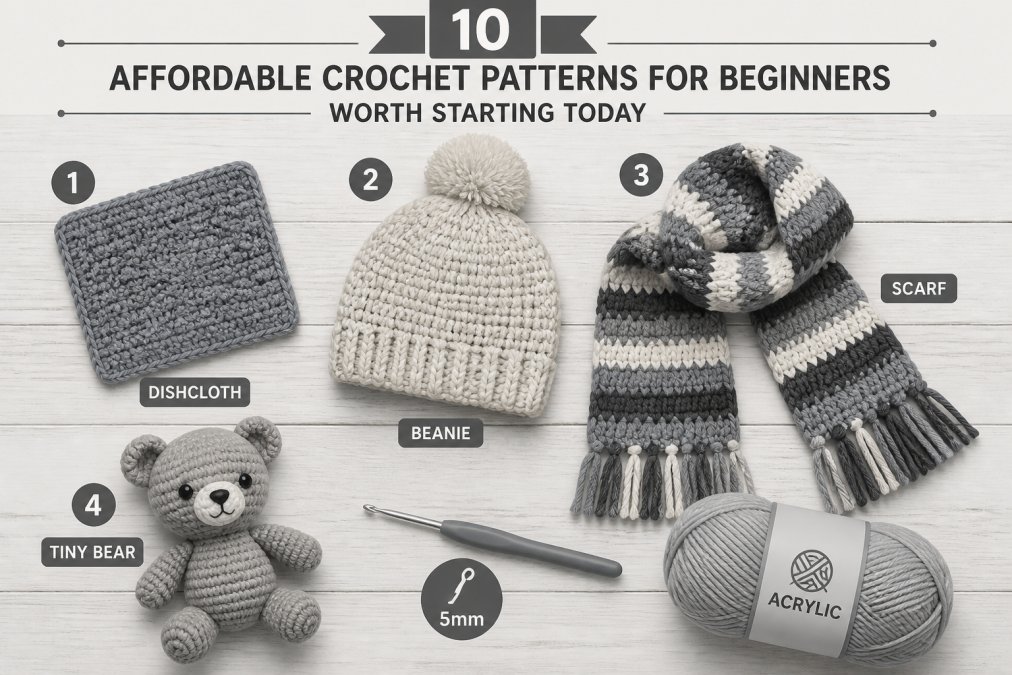
1. Simple Dishcloth (Under 2 Hours)
The dishcloth is the single best first project. It's flat, it's square, and it only uses chain stitch and single crochet. Chain 20, single crochet across, turn, repeat for 20 rows, fasten off, weave in ends. Done. Cotton yarn works best since it's absorbent and inexpensive. Time to complete: 1 to 2 hours.
2. Basic Beanie or Hat (2-4 Hours)
A beginner beanie is crocheted in the round, which introduces one new concept: joining rounds with a slip stitch instead of turning. Most free beginner hat patterns use double crochet and a 5.5mm hook with worsted weight yarn. The crown is worked in increasing rounds, then the body is straight rows until the hat reaches the right depth. Time to complete: 2 to 4 hours.
3. Beginner Scarf (3-5 Hours)
A scarf is nothing but long rows of the same stitch. That repetition builds muscle memory for tension and turning chains. Use a chunky yarn weight (size 6 bulky) with a 6mm hook to make it work up faster. A simple 15-stitch-wide scarf in double crochet will reach wearable length in 3 to 5 hours. Time to complete: 3 to 5 hours.
4. Mini Amigurumi Animal (4-6 Hours)
Amigurumi are small crocheted stuffed animals worked in continuous spiral rounds using single crochet. They look complicated but rely entirely on one stitch. The challenge is the magic ring start and learning increases and decreases. A small bear or bunny body is achievable for a beginner with patience. Time to complete: 4 to 6 hours.
5. Baby Blanket or Lap Afghan (8-15 Hours)
A baby blanket or lap afghan is the first project where yarn choice matters significantly. A smooth, machine-washable acrylic in a light color helps you see your stitches clearly. Most beginner afghans use double crochet rows in a single color or simple stripe pattern. Time to complete: 8 to 15 hours depending on size.
6-10. Five More Quick Wins for New Crocheters
6. Granny square coaster (1 hour): The granny square teaches you cluster stitches and corner chains in a small, manageable format.
7. Headband or ear warmer (1-2 hours): A flat rectangle joined at the ends. Uses double crochet and introduces sewing pieces together with a tapestry needle.
8. Market bag (3-4 hours): Worked in the round with a mesh stitch pattern. Introduces yarn overs and chain spaces in a forgiving, stretchy structure.
9. Chunky cowl (2-3 hours): A short, wide tube worked in the round with bulky yarn. Works up fast and looks impressive for the time invested.
10. Cardigan or vest (10-20 hours): The first wearable that requires gauge swatching. Save this for after you've completed at least three of the above projects.
Recommended Yarn Weights and Budget-Friendly Yarn Alternatives
Yarn weight is the thickness of the yarn, and it directly affects which hook size you use and how quickly a project works up. For beginners, weights 4 (worsted) and 5 (bulky) are the most forgiving.
Worsted weight acrylic yarn is the standard recommendation for new crocheters. It's smooth, consistent, and widely available at craft stores. It's also machine washable, which matters for anything you'll actually use. Cotton yarn is a good second choice for dishcloths and market bags since it holds its shape well.
Budget-friendly yarn alternatives are worth knowing. Store-brand acrylic from major craft chains performs almost identically to name-brand options for most beginner projects. Thrift stores and yarn swaps are genuinely good sources for practice yarn.
Yarn fiber content matters more as your skills grow. For beginners, smooth acrylic beats everything else for visibility and ease of correction.
Troubleshooting Common Beginner Crochet Mistakes
The most common beginner crochet mistake is working into the turning chain by accident, which adds an extra stitch to every row and causes your edges to fan outward. Count your stitches at the end of every row for your first five projects.
A common fix for uneven tension is to slow down deliberately and focus on pulling each loop to the same height. Many beginners crochet too tightly when concentrating hard. Loosening your grip on the yarn slightly usually fixes it.
Here are the mistakes that come up most often:
- Stitch count creeping up: You're accidentally inserting your hook into the turning chain. Count stitches at row end and identify where the extra stitch appears.
- Edges curling inward: Tension is too tight. Try the same pattern with a hook one size larger.
- Edges fanning out: Tension is too loose, or you're working into the turning chain. Tighten your yarn hold and recount.
- Holes appearing mid-row: You're splitting the yarn instead of going through the full stitch. Slow down and make sure the hook goes through the correct loop.
- Yarn splitting on the hook: Your yarn fiber content is loosely plied and the hook is catching individual plies. Switch to a smoother, tightly spun yarn.
When weaving in ends, run the tail through stitches in two different directions, not just one. One direction can work loose over time; two directions lock it in place.
According to The Spruce Crafts' crochet technique guides, most tension problems self-correct within the first few rows of a new project as your hands settle into a rhythm. If your gauge is still off after 10 rows, adjust your hook size rather than fighting your natural tension.
Where to Find Affordable Crochet Patterns for Beginners Online
Affordable crochet patterns for beginners are genuinely abundant online. The challenge is knowing which sources deliver well-written, clearly illustrated instructions.
Crochet Creations Hub offers premium digital crochet patterns as instant downloads, including beginner-friendly designs and pattern bundles. The patterns are formatted for clear printing and immediate use. A free pattern is available to download directly, making it easy to evaluate the quality before committing to a purchase.
For free pattern libraries, Ravelry's free pattern database is the largest in the world, with filters for skill level, yarn weight, hook size, and project type. User reviews on each pattern flag common issues before you start.
Yarnspirations' free beginner crochet patterns offers a dedicated beginner section with patterns designed around widely available yarn brands. Instructions are consistently clear and include step-by-step photos for most projects.
Many crocheters find it helpful to watch a YouTube tutorial alongside a written pattern. Searching for the exact pattern name plus "video tutorial" usually surfaces a walkthrough from an experienced crafter. Etsy is also a strong option for unique patterns at low cost, with most individual patterns priced affordably and reviews that indicate whether instructions are clear for beginners.
Frequently Asked Questions
What is the easiest thing to crochet as a beginner?
A simple dishcloth is widely considered the easiest first project. It uses only chain stitches and single crochet, requires very little yarn, and finishes in under two hours. The flat, rectangular shape means you never have to worry about shaping or increases. Once you can make a dishcloth consistently, scarves and beanies become straightforward next steps with the same core crochet stitches.
What supplies do I need to start crocheting on a budget?
You need three things to start: a crochet hook (a size 5 mm or 5.5 mm aluminum hook works for most beginner projects), a skein of worsted-weight acrylic yarn, and a tapestry needle for weaving in ends. Stitch markers help but a simple piece of contrasting yarn works just as well. Total startup cost is typically under $15 if you buy these essential crochet tools for beginners separately rather than in a branded kit.
How can I find affordable crochet patterns online?
Several platforms offer free crochet patterns for beginners, including large pattern databases, yarn brand websites, and craft tutorial sites. For premium, clearly written patterns at low cost, digital download marketplaces let independent designers sell individual patterns affordably. Crochet Creations Hub also offers free patterns alongside its paid collection, so you can check pattern quality before purchasing. Always look for patterns that list skill level, yarn weight, and hook size upfront.
How do I know if a crochet pattern is well-written before I buy it?
Look for patterns that clearly state the skill level, gauge, yarn weight, hook size, and a full list of crochet abbreviations used. A well-written pattern also includes stitch counts at the end of key rows so you can catch mistakes early. Customer reviews or finished project photos from other makers are strong signals of pattern quality. Many digital pattern sellers, including Crochet Creations Hub, offer free sample patterns so you can evaluate the format before committing.
What yarn weight is best for beginner crochet patterns?
Worsted weight (weight 4) acrylic yarn is the standard recommendation for beginner crochet patterns. It is thick enough to see your stitches clearly, widely available at craft stores, machine washable, and affordable. A size 5 mm to 6 mm crochet hook pairs well with it. Bulky yarn (weight 5 or 6) is even faster to work up and great for afghans or scarves, but the larger loops can make tension harder to control for absolute beginners.
Starting with the right projects makes all the difference between finishing your first scarf and abandoning a half-done heap of yarn in a drawer. Crochet Creations Hub makes it easy to find beginner-friendly patterns you'll actually complete, with instant digital downloads, free patterns to try before you buy, and a printable crochet planner to keep your projects organized. Get your free pattern from Crochet Creations Hub and make your first finished project happen this week.
This article was written using GrandRanker