

How to Read Crochet Patterns: A 2026 Guide
Table of Contents
- How to Read Crochet Patterns: The Basic Anatomy
- Crochet Abbreviations List: What Every Symbol Means
- US vs UK Crochet Terms: Why They Matter
- How to Read Crochet Charts and Symbol Diagrams
- Decoding Repeats, Asterisks, Brackets, and Parentheses
- Troubleshooting Common Pattern Errors
- Reading Complex Construction Patterns
- Conclusion
Last Updated: August 14, 2026
How to Read Crochet Patterns: The Basic Anatomy
Learning to read crochet patterns is the skill that separates a crafter who follows one tutorial forever from one who can pick up any design and make it their own. This guide breaks down every layer of pattern anatomy so you can read crochet patterns with confidence, whether you're working on a baby blanket, a market bag, or your first amigurumi.

A crochet pattern is a set of written or charted instructions that tells you exactly how to construct a finished piece. Most patterns begin with a header block containing all the information you need before you pick up your hook.
Skill Level, Materials, and Finished Measurements
The first thing most patterns list is the skill level: Beginner, Easy, Intermediate, or Advanced. These labels tell you whether the pattern uses basic stitches only or introduces techniques like working in the round or construction shaping.
Next comes the materials list, which specifies:
- Yarn weight (e.g., bulky, worsted, DK, fingering)
- Hook size (US letter size and millimeter equivalent)
- Yarn requirements in yards or grams
- Notions such as stitch markers, tapestry needle, or stuffing
Finished measurements tell you the dimensions of the completed piece, assuming you've matched gauge.
Gauge and Tension Requirements
Gauge is the number of stitches and rows that fit into 4 inches by 4 inches. Tension is the tightness of your individual stitches and directly affects gauge.
Most patterns state gauge like this: 14 sc x 16 rows = 4 inches in single crochet with a 5mm hook.
If your gauge swatch comes out larger than specified, your tension is too loose, go down a hook size. If it comes out smaller, your tension is too tight, go up a hook size. Skipping the gauge swatch is the most common reason a finished project ends up the wrong size. For garments and fitted items, gauge is non-negotiable. For decorative pieces like dishcloths or bookmarks, slight gauge differences matter less.
Crochet Abbreviations List: What Every Symbol Means
Every pattern uses shorthand to keep instructions readable. Once you've internalized the core abbreviations, they appear consistently across nearly every pattern you'll encounter.
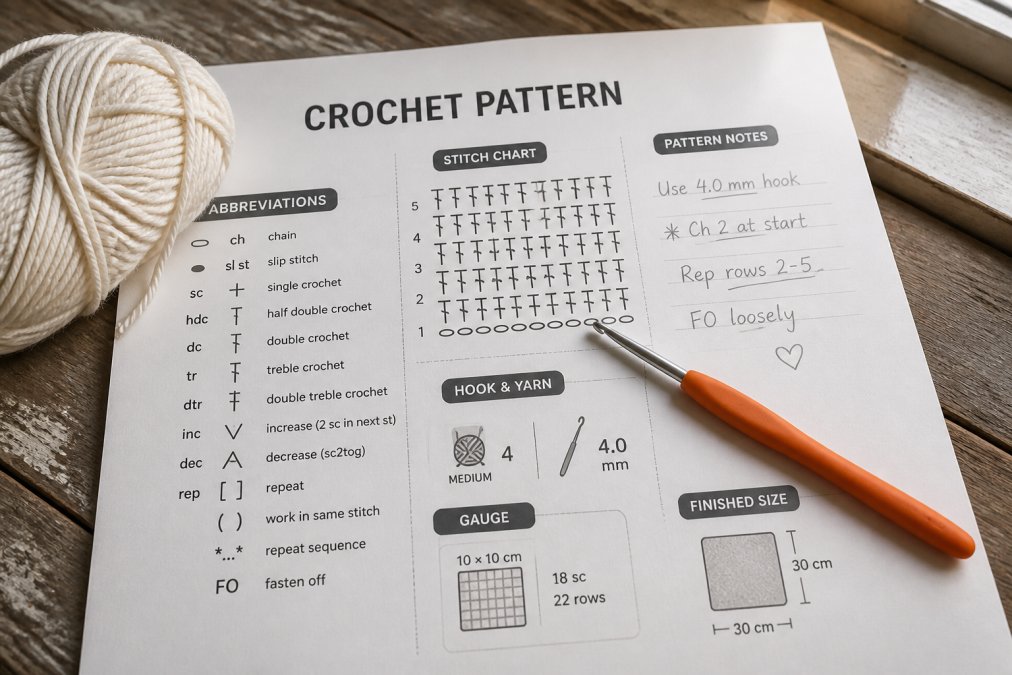
Common Stitch Abbreviations at a Glance
The following table covers the abbreviations you'll encounter most often in US crochet standards.
| Abbreviation | Full Name | What It Means |
|---|---|---|
| ch | Chain stitch | Foundation or turning chain |
| sl st | Slip stitch | Joining or moving without height |
| sc | Single crochet | Short stitch, 1 yarn over |
| hdc | Half double crochet | Medium stitch, 2 yarn overs |
| dc | Double crochet | Tall stitch, most common |
| tr | Treble crochet | Very tall stitch, 3 yarn overs |
| yo | Yarn over | Wrap yarn around hook |
| sk | Skip | Pass over specified stitch |
| st(s) | Stitch(es) | Individual stitch reference |
| sp | Space | Work into a chain space |
| BLO | Back loops only | Insert hook in back loop only |
| FLO | Front loops only | Insert hook in front loop only |
| inc | Increase | Work 2 stitches into 1 stitch |
| dec | Decrease | Work 2 stitches together as 1 |
| rep | Repeat | Work the sequence again |
| RS / WS | Right side / Wrong side | Which face of fabric is showing |
For a comprehensive reference, the Craft Yarn Council's standard abbreviations guide is the industry standard in the US.
Turning Chains, Yarn Over, and Loop Instructions
The turning chain is the chain stitch or stitches you work at the beginning of a row to bring your hook up to the correct height. Different stitches require different turning chain counts:
- Single crochet: 1 turning chain (often does not count as a stitch)
- Half double crochet: 2 turning chains
- Double crochet: 3 turning chains (often counts as the first dc)
Whether the turning chain counts as a stitch should be stated explicitly in the pattern. If unclear, check whether the stitch count at the end of the row includes or excludes the chain.
Yarn over means wrapping the yarn around your hook from back to front. Back loops only and front loops only instructions tell you which part of the V-shaped stitch top to insert your hook into. Working in the back loop only creates a ridged texture; working in the front loop only leaves a visible ridge on the opposite side.
US vs UK Crochet Terms: Why They Matter
US and UK crochet terminology use the same words to mean completely different stitches. A pattern written in UK terms will produce a completely different fabric than one written in US terms if you follow it using US stitch knowledge.
Here's the conversion table every crafter needs:
| US Term | UK Term | Height |
|---|---|---|
| Single crochet (sc) | Double crochet (dc) | Shortest |
| Half double crochet (hdc) | Half treble crochet (htr) | Medium-short |
| Double crochet (dc) | Treble crochet (tr) | Medium |
| Treble crochet (tr) | Double treble (dtr) | Tall |
| Slip stitch (sl st) | Slip stitch (sl st) | No height |
If a pattern doesn't specify US or UK terms, check where the designer is based. Designers from the UK, Australia, and New Zealand typically write in UK terms. If a pattern produces much taller fabric than expected, check whether you're working in the wrong regional system.
How to Read Crochet Charts and Symbol Diagrams
Crochet charts are visual representations of a pattern, where each stitch is shown as a standardized symbol. They're often more accurate than written instructions for complex construction patterns because they show exactly where each stitch lands.
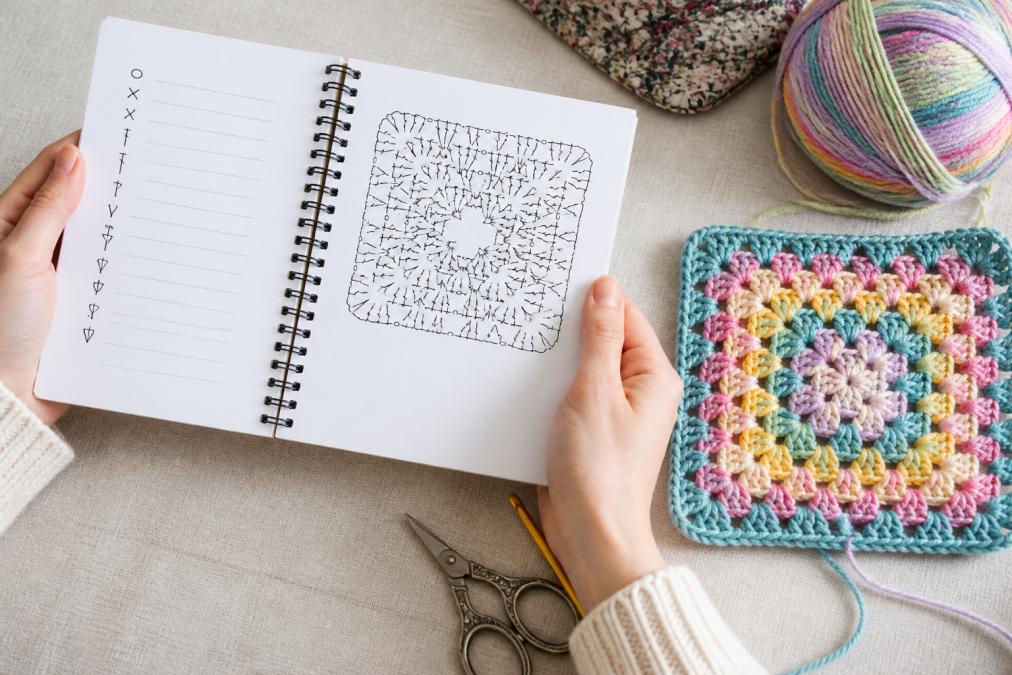
Reading the Symbol Legend
Every chart includes a symbol legend that maps each symbol to its stitch name. Common symbols include a small oval or dash for chain stitch, a small X or plus sign for single crochet, and T-shapes for double crochet and taller stitches. Always cross-reference the chart's own legend first, since some designers use slight variations.
Working in Rows vs. Working in the Round
Reading direction changes depending on construction method.
Working in rows: Charts read from bottom to top. Right-side rows read right to left. Wrong-side rows read left to right. This mirrors how you physically turn your work at the end of each row.
Working in the round: Charts start at the center and spiral outward. Each round reads counterclockwise. When working in the round, you typically do not turn your work, so the right side always faces you.
Decoding Repeats, Asterisks, Brackets, and Parentheses
Repeat sequences follow strict rules once you understand the notation.
Asterisks mark the start and end of a pattern repeat. The instruction sc in next 3 sts, dc in next st; rep from * to last 2 sts means you work the bracketed sequence across the row, stopping when only 2 stitches remain.
Parentheses serve two functions:
- Stitch groupings: Work all stitches inside the parentheses into the same stitch or space. Example: (2 dc, ch 1, 2 dc) in corner sp means all five elements go into one corner space.
- Size variants: When a pattern is written for multiple sizes, numbers for each size appear in parentheses. Pick your size at the start and circle every number in that position throughout the pattern.
Brackets typically indicate a sub-repeat within a larger repeat. The stitch count note at the end of a row or round, written as [24 sts] or (36 sc), tells you how many stitches you should have when complete. Always count at the end of each row when learning to read crochet patterns.
Troubleshooting Common Pattern Errors
Even well-written patterns have ambiguities. Knowing where to look when something goes wrong saves hours of frogging.
Stitch Count Doesn't Match
The stitch count doesn't match at the end of a row or round. This usually has one of three causes:
- Missed the turning chain rule. If the pattern says "ch 3, turn (counts as dc)" and you worked a dc into the same stitch as the chain, you've added an extra stitch. If you skipped the last stitch because you forgot the turning chain counts as a stitch, you've lost one.
- Misread a repeat. Count the stitches in your repeat sequence and multiply by the number of times you worked it. Add any edge stitches specified outside the asterisks. Compare to the target stitch count.
- Skipped or doubled a stitch. Run your hook under each stitch top as you count. Stitch markers placed every 10 stitches make counting faster and more accurate.
Navigating Digital Pattern PDFs
Most patterns today are delivered as PDFs. Practical tips for digital patterns:
- Use your PDF reader's bookmarks or thumbnail view to jump between sections without scrolling.
- Zoom in on charts to at least 150% before reading symbol details.
- Use annotation tools to highlight the size you're making in multi-size patterns.
- Print only the pages you'll actively reference at your hook.
- If a pattern PDF is blurry, the file may have been saved at low resolution. Well-produced digital patterns should print clearly at full page size.
Reading Complex Construction Patterns
Complex construction patterns include garments with shaping, modular designs built from joined motifs, and three-dimensional pieces like amigurumi. Before starting, read the entire pattern once without picking up your hook. Note where construction changes direction, where pieces are joined, and where stitch counts shift dramatically.

For garment patterns with shaping, mark every decrease and increase row on a printed copy. Identify the armhole, neckline, and sleeve instructions before you reach them. Track your row count with a physical counter or project tracker.
For modular and motif-based patterns, the joining method matters as much as the individual motif. Patterns specify whether you join motifs as you go or seam them afterward.
For amigurumi and three-dimensional work, the round count and stitch count together tell you the shape. Increasing rounds expand the sphere; decreasing rounds close it. The rate of increase or decrease controls the curve.
The free Ultimate Crochet Planner from Crochet Creations Hub is a 120-page printable journal that includes project tracking pages, stitch count logs, and notes sections designed specifically for multi-step tracking complex patterns demand.

Reading crochet patterns gets faster with every project. The abbreviations become automatic, the charts start to make visual sense, and the repeat notation stops looking like code. If you're ready to put these skills to work, Crochet Creations Hub offers a full library of clearly written digital patterns, from beginner-friendly bookmarks and market bags to intermediate basket and amigurumi designs, each available as an instant download. Grab your free pattern and start your next project with a pattern that's built to be read.
Frequently Asked Questions
How do you read crochet patterns for beginners?
Start at the top of the pattern and read through the entire thing before picking up your hook. Check the materials list for yarn weight and hook size, then review the abbreviations key so every stitch name is clear. Patterns move row by row or round by round, follow the stitch count at the end of each row to confirm you're on track. The free Ultimate Crochet Planner from Crochet Creations Hub is a great tool for jotting down row counts as you go.
What do common abbreviations in crochet patterns mean?
The most frequent ones are: ch (chain stitch), sc (single crochet), dc (double crochet), hdc (half double crochet), sl st (slip stitch), sk (skip), and rep (repeat). Patterns also use BLO (back loops only) and FLO (front loops only) to modify where you insert the hook. Every pattern should include its own abbreviations list, always check that first, since some designers use non-standard shorthand.
What is the difference between US and UK crochet terminology?
The stitch names shift by one level between US and UK patterns. A US single crochet is called a double crochet in UK terms. A US double crochet becomes a UK treble crochet. This means using a UK pattern with US assumptions, or vice versa, will produce a completely different fabric. Always check whether a pattern specifies US or UK terminology before you start, especially with patterns sourced from international sites or older books.
How do you read a crochet stitch diagram or chart?
Crochet charts use standardized symbols to represent each stitch, a small oval for a chain, an X or plus sign for single crochet, a T-shape for double crochet. Read flat rows from right to left on odd rows, then left to right on even rows. Rounds are read counterclockwise from the center outward. Every chart should include a symbol legend; if it doesn't, cross-reference the Craft Yarn Council's standard symbol guide.
How do I interpret brackets and asterisks in a crochet pattern?
Asterisks mark the start of a repeat sequence. When you see * sc, ch 1, sk 1 *, repeat from * to * across, you work that sequence across the entire row. Brackets [ ] group stitches worked into the same stitch or space, for example, [2 dc, ch 1, 2 dc] in corner sp means all four stitches go into that one corner space. Parentheses often hold size variations, such as (S, M, L), so you follow only the numbers that match your size.
Are there standard symbols used in all crochet patterns?
The Craft Yarn Council publishes a standardized symbol set that many US designers follow, but not all patterns use it. International patterns, especially those translated from Japanese or European sources, may use different symbols entirely. Always read the symbol legend included with the specific pattern rather than assuming universal meanings. If no legend is provided, contact the designer or check their website for a reference guide.
This article was written using GrandRanker