

10 Best Baby Crochet Patterns for Beginners in 2026
Table of Contents
- Quick Comparison: 10 Best Baby Crochet Patterns for Beginners
- Beginner Crochet Stitches for Baby Projects
- 1. Free Pastel Shells Baby Blanket Crochet Pattern
- 2. Easy Peasy Crochet Baby Blanket Pattern
- 3. Vintage Vibes Baby Beanie Crochet Pattern
- 4. Baby Booties Crochet Pattern (3, 6, 12 Months)
- 5. Bunny Booties Crochet Pattern PDF
- 6. Baby Ballet Flats Crochet Pattern
- 7. Boho Bunny Lovey Crochet Pattern
- 8. Bunny Lovey Crochet Pattern PDF
- 9. Bunny Stacking Toy Crochet Pattern
- 10. Newborn Scratch Mitts and Sizing Guide
- Best Yarn for Baby Crochet Projects
- How Long Does It Take to Crochet a Baby Blanket?
- Troubleshooting Common Beginner Mistakes
- What to Look for in a Beginner Baby Crochet Pattern
- Frequently Asked Questions
Last Updated: September 13, 2026
Quick Comparison: 10 Best Baby Crochet Patterns for Beginners
This guide from Crochet Creations Hub offers ten baby crochet patterns, ranked by difficulty, each with the yarn weight, hook size, and realistic time estimate you need before buying a single skein.
Below: how to pick a first project without wasting yarn, plus a sizing chart and troubleshooting section.
| # | Pattern | Skill Level | Yarn Weight | Hook Size | Time to Complete |
|---|---|---|---|---|---|
| 1 | Pastel Shells Baby Blanket | Beginner | Worsted | 6 mm (J/10) | 8-12 hours |
| 2 | Easy Peasy Baby Blanket | Beginner | Worsted | 6 mm (J/10) | 10-14 hours |
| 3 | Vintage Vibes Baby Beanie | Advanced Beginner | DK (Category 3) | 4.0 mm (G) | 2-3 hours |
| 4 | Baby Booties (3, 6, 12 Months) | Beginner | Medium weight | 4.0 mm (G/6) | 2-3 hours |
| 5 | Bunny Booties PDF | Intermediate | Mercerized cotton | 2-2.5 mm | 4-6 hours |
| 6 | Baby Ballet Flats | Beginner to Intermediate | Worsted | 3.25-3.75 mm | 3-4 hours |
| 7 | Boho Bunny Lovey | Beginner | Super Bulky (#6) | 6 mm (J) | 3-4 hours |
| 8 | Bunny Lovey Comforter | Medium | Bamboo (fine) | 2.5-3.0 mm | 5-7 hours |
| 9 | Bunny Stacking Toy | Intermediate | Cotton (sport) | 3 mm | 6-8 hours |
| 10 | Newborn Scratch Mitts | Beginner | Fingering | 3.0 mm | 1-2 hours |
Beginner Crochet Stitches for Baby Projects
Five stitches cover nearly every baby pattern on this list: chain, slip, single crochet, double crochet, and shell stitch. Master those five and you can make a blanket, hat, booties, and a lovey without learning anything new.

The foundation chain is where beginners lose confidence. Keep tension loose enough that your hook slides through each chain without tugging. A 10-stitch gauge swatch tells you more about your tension than any tutorial.
Here is what each stitch actually does in a baby project:
- Chain stitch (ch): builds your foundation chain and adds height at the start of rows
- Slip stitch (sl st): joins rounds and moves across a row without adding height
- Single crochet (sc): the tightest, most durable stitch; ideal for bootie soles and toy pieces
- Double crochet (dc): faster to work, softer drape; the backbone of blankets
- Shell stitch: clusters of double crochet worked into one stitch, creating the textured pattern repeat on the Pastel Shells blanket
1. Free Pastel Shells Baby Blanket Crochet Pattern
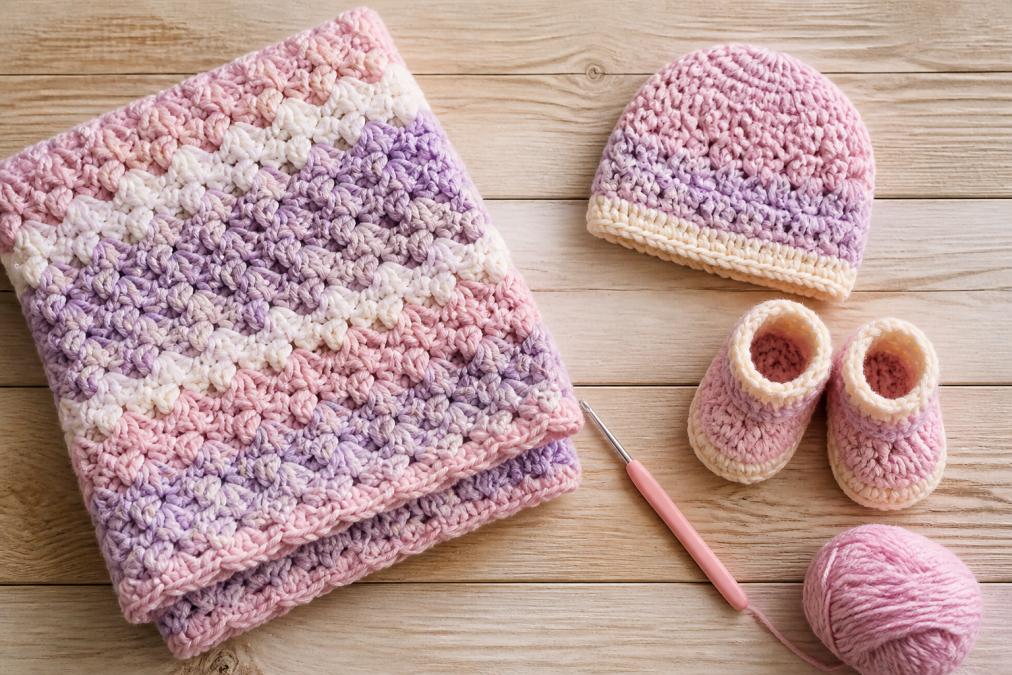
The best first baby blanket is a free one, and this is it. The Pastel Shells Baby Blanket Crochet Pattern is a beginner-friendly PDF built around one repeating shell stitch: learn a single repeat, then keep going. No mid-row color changes, no shaping, no assembly. Worked in soft worsted-weight or baby yarn on a 6 mm hook, it produces breathable, textured fabric.
Best for: absolute beginners making a baby shower gift on a deadline.
The honest drawback: shell stitch eats yarn faster than plain double crochet, so budget more skeins than you think you need.
2. Easy Peasy Crochet Baby Blanket Pattern
Where Pastel Shells teaches a stitch pattern, the Easy Peasy Crochet Baby Blanket Pattern teaches rhythm. It uses only chain, double crochet, and slip stitch in an easy repeating sequence, finishing at roughly 40" x 40" (101.5 cm x 101.5 cm), generous enough for a stroller blanket or tummy-time mat.
The 6 mm (J/10) hook and worsted weight yarn make it a fast blanket to work; a steady beginner working evenings finishes in about two weeks.
Best for: makers who want a large finished object without a complex pattern repeat.
Where it falls short: because the stitch is simple, the visual interest comes entirely from your yarn choice. Pick a self-striping or tonal yarn, or the finished blanket will look plain.
3. Vintage Vibes Baby Beanie Crochet Pattern
Hats are the fastest confidence win in crochet. The Vintage Vibes Baby Beanie Crochet Pattern includes a diamond flower motif plus Sweet & Simple, Twice As Nice, and Matchy Mummy variations, bonus preemie sizes, and optional earflap instructions.
In DK weight (Category 3) yarn on a 4.0 mm (G) hook, a newborn beanie takes two to three hours, a single evening.
Best for: last-minute gifts and newborn photography props, where texture reads better than size.
The catch: the floral motif version requires you to track a pattern repeat across rounds. Start with the Sweet & Simple variation if this is your first hat.
4. Baby Booties Crochet Pattern (3, 6, 12 Months)
Booties look intimidating and mostly are not. This Baby Booties Crochet Pattern uses a classic ribbed cuff and beginner-friendly construction in three sizes, 3, 6, and 12 months, with just a 4.0 mm (G/6) hook and medium weight yarn. The ribbed cuff is the detail that matters: it grips a wriggling foot, the difference between booties that stay on and booties that end up in a diaper bag within ten minutes.
Best for: pairing with a matching blanket as a coordinated baby shower gift.
What most guides miss: booties are the one baby project where gauge genuinely matters. Measure the baby's foot before you choose a size, and check your stitch gauge before you start the sole.
5. Bunny Booties Crochet Pattern PDF
Here the difficulty curve bends upward. The Bunny Booties Crochet Pattern PDF is intermediate and earns the label: four baby sizes with foot lengths from roughly 3.5" (9 cm) to 4.7" (12 cm), plus upright bunny ears, a shaped toe, a textured ribbed cuff, and adjustable shoelaces. It specifies 100% mercerized cotton on a 2 mm or 2.5 mm hook, gauge 26 double crochet by 13 rows to 4" (10 cm), and includes video tutorial links for the construction stages.

Best for: crocheters who have finished at least one pair of simple booties and want a keepsake-quality gift.
The real difference between this and pattern #4: four separately crocheted, folded, and attached bunny ears. Attaching them evenly is the fiddly part. Pin before you sew.
6. Baby Ballet Flats Crochet Pattern
The Baby Ballet Flats Crochet Pattern includes three sizes (newborn 3.75", 3-6 months 4.25", 6-12 months 4.75"), three strap styles, and a decorative flower pattern, worsted weight for the shoe, fingering for the flower, hooks in 3.75 mm (F) and 3.25 mm (D). They photograph beautifully, suit christenings and first birthdays, and the strap options mean the same pattern three times yields three visibly different shoes.
Best for: special-occasion gifts and newborn photography props.
One limitation: the decorative flower is worked in a finer yarn than the shoe, so you will need two yarn weights on hand. Plan for that before you start.
7. Boho Bunny Lovey Crochet Pattern
A lovey is a small plush plus a comfort blanket, both toy and soothing object, and it works up fast in super bulky (#6) yarn on a 6 mm (J) hook. The Boho Bunny Lovey Crochet Pattern is beginner-friendly, with written instructions for the bunny head, floppy ears, lovey blanket, assembly, and finishing.
Best for: a fast, cuddly gift that looks far more advanced than it is.
8. Bunny Lovey Crochet Pattern PDF
The finer, more detailed sibling of pattern #7. The Bunny Lovey Crochet Pattern PDF runs 18 pages with step-by-step instructions and progress photographs covering head, ears, forelegs, hind legs, tail, and body, using 2.5 mm and 3.0 mm hooks with gray and teal-blue yarn plus embroidery floss for the sleepy eyes and tiny nose.
At a "Medium" skill rating, it asks more than the bulky version: smaller hooks, finer yarn, and visible stitching mean your tension shows.
Best for: intermediate makers who want a nursery keepsake with real detail.
The thing nobody tells you: fine yarn and small hooks punish uneven tension. Make a gauge swatch first, or your bunny's head will be noticeably lopsided.
9. Bunny Stacking Toy Crochet Pattern
Baby toys are an underrated beginner project, and this one is a showpiece. The Bunny Stacking Toy Crochet Pattern combines an amigurumi bunny with removable stuffed stacking rings, large, middle striped, and small striped, plus a pom-pom tail and step-by-step assembly photos across 15 pages.

It uses a 3 mm hook with cotton yarn in white, pink, turquoise, and yellow, and teaches magic ring, increases, decreases, back loop only, and front loop only, the core amigurumi skills, all in one project.
Best for: beginners who want to learn amigurumi through a project a baby can actually play with.
Where it falls short: assembly is the hard part, not the crochet. Sew every component securely, and choose age-appropriate facial features for a young child.
10. Newborn Scratch Mitts and Sizing Guide
Scratch mitts are a small, fast project here. A pair takes one to two hours in fingering weight yarn on a 3.0 mm hook, addressing a common issue: newborns can scratch their own faces.
Sizing is where most beginners go wrong, so use this as your reference before starting any of the ten patterns above:
- Preemie: hat circumference 10-12", foot length 3" (7.5 cm)
- Newborn to 3 months: hat circumference 12-14", foot length 3.5" (9 cm)
- 3 to 6 months: hat circumference 14-16", foot length 3.9" (10 cm)
- 6 to 9 months: hat circumference 16-17", foot length 4.3" (11 cm)
- 9 to 12 months: hat circumference 17-18", foot length 4.7" (12 cm)
- 12 to 24 months: hat circumference 18-19", foot length 5.5" (14 cm)
Always measure the baby's foot or head rather than trusting an age label. Babies do not read sizing charts.
Best Yarn for Baby Crochet Projects
The best yarn for baby crochet is soft, machine-washable, hypoallergenic, and light in color, superwash wool, cotton, and acrylic blends all fit (textiles.ncsu.edu). Parents often wash baby items frequently, so machine-washable options are convenient.
Fiber choice changes the finished object more than any other decision:
- Superwash wool: warm, breathable, machine washable; ideal for hats and booties
- Cotton (including mercerized cotton): durable, holds stitch definition, no fuzz; the right call for booties and toys
- Acrylic and acrylic blends: budget-friendly, easy care, widely available in baby-friendly pastels
- Bamboo and bamboo blends: silky and cool against skin; good for loveys and summer blankets
- Super bulky yarn: fast to work and plush, but too heavy for anything a baby wears
Avoid dark, heavily dyed yarns for a first project, as they can hide stitch definition. Pastels can be a learning aid.
How Long Does It Take to Crochet a Baby Blanket?
A baby blanket takes most beginners 8 to 14 hours of active crochet time, spread across one to three weeks of evenings (craftyarncouncil.com). Pastel Shells runs 8 to 12 hours; the larger Easy Peasy runs 10 to 14.
Three variables move that number more than anything else:
- Yarn weight. Super bulky works up roughly twice as fast as worsted.
- Stitch height. Double crochet covers ground far faster than single crochet.
- Your tension. A tight crocheter works slower and uses more yarn than a relaxed one.
Track your hours on your first blanket: that number becomes your benchmark and makes every future deadline realistic.
Troubleshooting Common Beginner Mistakes
Most beginner frustration traces back to four fixable problems, and none of them mean you are bad at crochet.
Your edges keep growing or shrinking. You are adding or dropping a stitch at the turn. Count your stitches at the end of every row for the first ten rows.
Your blanket curls at the corners. Your foundation chain is too tight. Go up one hook size for the chain only, then switch back.
Your stitch count never matches the pattern. You are probably working into the wrong loop. The top of a stitch has two loops; work under both unless the pattern says back loop only.
Your finished piece is the wrong size. Your tension differs from the designer's. Make a gauge swatch and adjust your hook size before starting, not after.
What to Look for in a Beginner Baby Crochet Pattern
A pattern earns the "beginner" label when it uses basic stitches, avoids mid-row color changes, requires no shaping, and states its gauge. Missing any of those four, it is not a beginner pattern regardless of marketing. Read the whole pattern before buying yarn: skill level, materials list, finished size, and whether a video tutorial is included. Patterns with step-by-step photographs and video links can be easier to follow than text-only instructions. Also check print quality: a blurry chart can be difficult to use, and every pattern here is a digital download you can print at full size and reuse.
Picking a first baby crochet pattern is a question of matching the project to the time and skills you actually have, not the ones you hope to have. Start with the free Pastel Shells or Easy Peasy blanket for a finished gift you can be proud of, or the Vintage Vibes beanie for a win in a single evening. Crochet Creations Hub offers instant digital downloads, pattern bundles, and a printable crochet planner to keep every project on track, all backed by a 5.0 / 5.0 rating on featured products. Get your free pattern from Crochet Creations Hub and start your first baby project tonight.
Frequently Asked Questions
What is the easiest thing to crochet for a baby?
A simple blanket is usually the easiest first project. The Easy Peasy Crochet Baby Blanket uses only chain, double crochet, and slip stitch, so you can focus on tension and gauge without juggling complex stitch counts. A basic beanie is the next step up, and booties are the smallest. Start with worsted weight yarn and a 6 mm (J/10) hook so your stitches are easy to see and unravel if you make a mistake.
What yarn is best for baby crochet projects?
Soft, washable fibers work best. Superwash wool, cotton blends, and acrylic blends labeled hypoallergenic are common picks because they survive frequent washing and feel gentle on newborn skin. Match the yarn weight to the pattern: worsted weight for blankets, DK weight for beanies, and medium weight for booties. Avoid scratchy wool and any yarn with loose fibers that could shed near a baby's face.
How long does it take to crochet a baby blanket for beginners?
A 40 x 40 inch blanket in worsted weight yarn with a 6 mm hook typically takes 12 to 20 hours for a beginner. That breaks into about two to three weeks of evening crocheting. Smaller projects move faster: a beanie takes 2 to 3 hours, booties 3 to 4 hours, and a lovey 4 to 6 hours. Your first blanket will be slower than your second because you are still building tension and reading pattern repeats.
Are crochet baby items safe for newborns?
Yes, with a few precautions. Use hypoallergenic, washable yarn and skip small embellishments like beads or buttons that could come loose. For toys, embroider facial features instead of attaching safety eyes unless the pattern specifies secure locking backs. Wash finished items in fragrance-free detergent before gifting. Supervise tummy time with any crocheted toy, and keep blankets out of the crib for sleep until your pediatrician clears them.
What are the best crochet stitches for baby blankets?
Shell stitch, single crochet, and double crochet all work well because they create a soft, breathable fabric without gaps. The Pastel Shells Baby Blanket uses a repeating shell stitch that hides small tension changes and looks polished even for a first project. Avoid open lace patterns with large holes for newborns, since tiny fingers can get caught. A gauge swatch in your chosen stitch confirms the finished size before you commit to a full blanket.